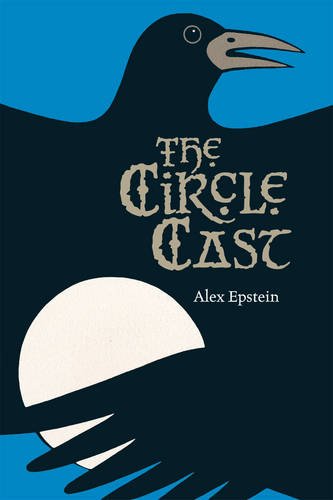
Alex Epstein is here today with a guest post courtesy of the Teen Book Scene blog tour for his new release, The Circle Cast. Thank you for being here, Alex! You can follow along with the tour here, or by clicking through the banner. There is a giveaway attached to the tour as well. Anyone who comments on any of the posts will be entered to win an E-book of The Circle Cast. There will be a winner for each week of the tour. Enjoy!

Mythology and History. How did that affect the writing of The Circle Cast and your vision of the book?
The Circle Cast is historical fantasy. I tried to get two things right: the times, and the magic.
I read a fascinating book by Geoffrey Ashe, The Discovery of King Arthur, that convinced me that the real King Arthur flourished around 470AD. He shows up in histories under the name Riothamus, but that just means “High King.” He probably wasn’t actually a king; the Celtic Brits were too fractious for that. He was probably just a war leader appointed by the various British tribes, who were desperate to stop a rising tide of Saxon immigration. And by immigration, I mean that each wave of Saxons would come, beat the pants off the British, and take their farmland, pushing them West into Wales.
There’s a brief time in British archeology and history where the History of the Saxons is suddenly very quiet – no victories to report – and the hillfort at Cadbury Castle is rebuilt in the Roman style, and a Romano-British leader named Riothamus may have been clobbering the Saxon footmen from horseback. That’s where King Arthur comes from, I’m convinced.
Which is great for my story. The medieval romances put King Arthur in medieval times; he’s a feudal king. 470AD is a much more interesting time. It’s a time when all bets are off. It’s just a hundred years after the last Roman legions marched off the island. The British elites must have thought of themselves as civilized and Roman. They probably spoke and wrote in Latin and, if they were very educated, Greek. They lived in a big world. They traded with Spain and probably had pen pals as far as Jerusalem. These illiterate barbarian Saxons must have seemed like the end of the world.
It’s also a time when religion is up for grabs. Christianity had been illegal in the Empire until only about two hundred years ago. Some of the Brits would have been Christian. Some of them would have been faithful to the old pagan gods. And many of them would have worshipped Jesus on Christmas and Lugh on Lugnasahd.
What makes all of this so great for my story is that Morgan is torn between the old ways and the new. People had different values in those days. To a pagan, pride was not a sin, it was a virtue. Vengeance was a righteous act. A son who did not try to avenge the murder of his father was not a saint, he was a coward. So one path open to Morgan is the old pagan path. To be true to herself, she has to seek revenge on Uter for murdering her father and taking her mother from her.
And there’s another path open to her. She can become Christian, and forgive. The problem is, who is she then? A lot of people gave up their old names when they converted. She wouldn’t be Morgan, heir to Tintagel, any more. She’d be, who knows, someone named Mary or Martha or Susan.
Arthur probably takes this path. He’s full of forgiveness and understanding, even when his best friend and his wife betray him.
But Morgan can’t. If she abandons her gods, she’ll lose her power. Worse, if she abandons her gods, she’ll lose her identity. And she’s an exile, practically an orphan. Her identity is all she has.
The interesting thing is that Arthur’s Christianity is what makes Camelot a shining ideal that enables him to unite the kingdom. But it also is his downfall. If he had been a little less forgiving, he’d have executed Guinevere and Lance. He’d have married again, and had more kids, and Camelot would have lived on.
Or, for that matter, if he’d a little more pagan, he could have accepted his bastard son Mordred as his heir, and instead of the battle of Camlann, in which the British knights slaughtered each other, father and son would have led them against the Saxons. The pagan Celts didn’t make such a big fuss about marriage. They didn’t have much of a concept of bastardy. And I’m not even sure they would have felt it was a big deal if Arthur wanted to marry his half-sister.
The great tragic characters have the virtues of their vices and the vices of their virtues. Morgan’s anger destroys her world, in the end, but if she hadn’t been angry, we’d never have heard of her. Arthur’s graciousness allows him to rule the squabbling Brits, but in the end he doesn’t have the ruthlessness he needs to finish off the Saxons.
Of course Camelot is a legend. But they’ve always felt very real to me. Real to the point that I can read a novel about Arthur and feel, but it didn’t happen that way! For example, I found The Mists of Avalon very frustrating because Morgan comes across as a gracious girl who’s very reasonable and only wants the best for everybody. But what makes her such a great character is that she’s not gracious, she’s not at all reasonable, and she only wants the best for her clan. In other words, she’s a pagan Celt.
So I tried to get the times right. I did a lot of historical research. I went to England and Ireland. I saw recreations of Celtic villages. The four-horned sheep are accurate. So are the huts without chimneys – chimneys came in around 1200 AD. Roman carts didn’t have axles. The Irish couldn’t ride horses because their ponies were too small to do anything but pull carts. Stuff like that. If there’s a detail that just feels odd, it’s probably accurate.
I really wanted to get the magic right, too. But I had two conflicting sources. We know something about pagan Celtic religion, but we have to piece it together. The Irish were illiterate until the priests came. The British learned to write when the Romans arrived, but Roman writers liked to equate Celtic gods with Roman ones, so they’d talk about the Celts worshipping Mars or Mercury. We have archeological shrines from the Continent with places for heads – the Celts were probably headhunters. I was fortunate that when I was first working on the novel, my first wife was working on her dissertation about the Celtic war goddess, known as Morigenos or the Morrígan. So Morgan’s religion comes from all that research.
But her magic would have been different. Morgan didn’t need to have faith in a higher power. She channeled power. So whatever her religion, she also had magic. She had a direct line to the powers of the earth.
Obviously, there’s no historical record of magic. Magic is secret, and silent, and not something you can write down. Also, it’s imaginary.
So I used contemporary Wicca. I did a lot of spiritual seeking when I lived in California. I wound up being initiated into a Wiccan coven. The closest I’ve ever experienced magic was watching a woman draw down the Moon. It really felt as if she’d invoked someone very old and very powerful inside of her. It really felt as if the circle cast around us was no longer entirely in our normal world, but between the worlds.
So that’s what I gave Morgan.
What I think historical fantasy gives that ordinary swords-and-sorcery doesn’t is a real grounding in detail. I love The Lord of the Rings, too, but why aren’t there any fields around Minas Tirith? What do the orcs live on, if there are thousands of them underground? I felt the more accurate I could make the historical parts of the story, the more real the magic would feel. I hope I’ve accomplished that.
Thank you for this insightful and amazing post, Alex! I'm currently reading The Circle Cast and loving it!
Alex Epstein can be found on his website, and on his blog.
-------------------------
How did an exiled girl become the most powerful witch in legend?
Britain, 480 AD. Saxon barbarians are invading, pushing the civilized British out of their own island. Morgan is the daughter of the governor of Cornwall. But when her father is murdered and her mother taken as the King's new wife, she has to flee to Ireland to avoid being murdered herself.
But Ireland is no refuge. She's captured in a slave raid and sold to a village witch. As Morgan comes of age, she discovers her own immense magical powers. She falls in love with a young Irish chieftain, and makes him powerful.
But will her drive for revenge destroy her one chance for love and happiness?